Remember when the word ‘trendy’ was, well, trendy? Yet now it is the kiss of death for anything purporting to be modern, innovative, or contemporary — used by people trying desperately to sound ‘cutting edge’ (is this the replacement for ‘trendy’?).
We are all constantly bombarded with change, software updates, new ‘rules’, and fashionable terms. We are urged to keep moving with the times, or risk the infamy caused by using an outdated word to mean ‘up to date’.
This brings me, rather circuitously, to the knotty issue of the number of spaces that should be used after a full stop in normal text. When editors receive a document with double spaces after full stops (or worse!), we tend to sigh and resignedly bring up the Search and Replace function. (But we never use the Search and Replace All option: we’ve all clicked this once in a burst of optimism, with disastrous results.)
The Heraclitean River blog addresses this question comprehensively in its essay here — but leaves editors mumbling into their (metaphorical) beards. In changing times we all tend to accept reasoning when it is backed up by enough people who agree with us. We’re not joining the Flat Earth Society, but it may be time for us to be a little more flexible about the thorny spacing issue.
By Corinna Lines
This blog shares some of our thoughts about plain language, and the latest discussions about plain English and clear design in New Zealand, and around the world.
To find out more about Write, go to http://www.write.co.nz/ or join us on Facebook at http://www.facebook.com/WriteLimited
13 November 2013
12 November 2013
From our bookshelf: FISH! Tales
At every staff meeting the chair reviews a book from our bookshelf, to remind us of the wealth of knowledge we have at our fingertips.
Jack Ponting, our client services co-ordinator, picked FISH! Tales. Here's what he said:
'The series of FISH! books are based around a special fish market in Seattle. They contain real-life stories to help you transform your workplace and your life.
'They promote four principles for engaging:
- play
- make their day
- be there
- choose your attitude
'Living this philosophy results in a workplace where the quality of life is satisfying and meaningful, and the experience for customers, internal and external, is compelling.
'PLAY — Work made fun gets done, especially when we choose to do serious tasks in a light-hearted, spontaneous way. Play is not just an activity; it’s a state of mind that brings new energy to the tasks at hand and sparks creative solutions.
'MAKE THEIR DAY — When you ‘make someone’s day’ (or moment) through a small kindness or unforgettable engagement, you can turn even routine encounters into special memories.
'BE THERE — The glue in our humanity is in being fully present for one another. Being there is also a great way to practise wholeheartedness and fight burnout, for it is those half-hearted tasks you perform while juggling other things that wear you out.
'CHOOSE YOUR ATTITUDE — When you look for the worst, you will find it everywhere. When you learn you have the power to choose your response to what life brings, you can look for the best and find opportunities you never imagined possible. If you find yourself with an attitude that is not what you want it to be, you can choose a new one.
'Applied Principles touched many who applied them in their workplaces. This book is a collection of some of these stories and experiences.
'On page 137 the challenge is offered to ‘Let’s go fishing!’ This offers 12 weeks of discovering the richer and more rewarding life that is just a few choices away.
'William Hope, from Arrow Electronics UK Limited said, ‘The FISH! Philosophy has spread across our organisation like an electric shock, leaving people tingling with the energy it leaves behind.’
Thanks, Jack, for advice that enhances happiness at work, and outside it.
FISH! Tales is by Stephen C Lundin, John Christensen, and Harry Paul.
Take a look on Amazon
17 October 2013
I hope I've done the right thing
We attach the word ‘literacy’ to many areas of information in the new century—food, media, computers, health. ‘Financial literacy’ is an important term to know and important skill to have for people like me approaching retirement.
Today I phoned a financial organisation to take out my small investment. My adviser had told me to use the word ‘repurchase’, so that I got the money by cheque. When I phoned the organisation, the person who answered the phone refused to use the word ‘repurchase’, and said I must want to ‘redeem’ or ‘withdraw’ the money. He’s sending a form. I hope I’ve done the right thing.
Post written by Rosie Knight
12 October 2013
PLAIN 2013 Conference enlightens and inspires
What a privilege to be in Vancouver for the PLAIN 2013 Conference as hundreds of plain language practitioners and supporters from 19 countries commune. Or if the predictions of Neil James in this morning's plenary come true, we'll be plain language practitioners no more. We'll redefine our somewhat fragmented, multi-disciplinary profession as 'clear communication'. Our various disciplines from writer or editor to information designer, technical writer, or usability consultant (did I forget any?) will converge. No more problems describing your profession at those pesky school reunions.
In the second plenary, we heard the latest news about IC Clear from Karine Nicolay. Soon you'll be able to enrol in an international post-graduate course in clear communication.
Read about IC Clear
World Cafe followed, with 20 topics to choose from for a series of interactive roundtable discussions. We conversed through three topics for 20 minutes each. The themes of the ones I chose were: achieving long-term change, embedding clear language principles and practice within an organisation, and selling the need for plain language to management.
Legal language in legal aid and pro bono projects was the topic for after lunch. The country is different (the Canadian experience), but the problems are the same. Then an entertaining session of time-saving tips with Marcia Riley of Write Like a Pro fame before Josiah Fisk (More Carrot) delighted us with his maxims for messages and meta-messages, presented in his wonderfully visual way and timed to a tee.
The keen ones (most of them, I think) stayed on for the late shift when Sarah Stacy-Baynes and I presented together on the Cancer Society's project to rewrite their information booklet on lung cancer.
Looking forward to more inspirational stuff tomorrow.
Read more about PLAIN2013
In the second plenary, we heard the latest news about IC Clear from Karine Nicolay. Soon you'll be able to enrol in an international post-graduate course in clear communication.
Read about IC Clear
World Cafe followed, with 20 topics to choose from for a series of interactive roundtable discussions. We conversed through three topics for 20 minutes each. The themes of the ones I chose were: achieving long-term change, embedding clear language principles and practice within an organisation, and selling the need for plain language to management.
Legal language in legal aid and pro bono projects was the topic for after lunch. The country is different (the Canadian experience), but the problems are the same. Then an entertaining session of time-saving tips with Marcia Riley of Write Like a Pro fame before Josiah Fisk (More Carrot) delighted us with his maxims for messages and meta-messages, presented in his wonderfully visual way and timed to a tee.
The keen ones (most of them, I think) stayed on for the late shift when Sarah Stacy-Baynes and I presented together on the Cancer Society's project to rewrite their information booklet on lung cancer.
Looking forward to more inspirational stuff tomorrow.
Read more about PLAIN2013
10 October 2013
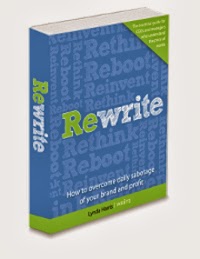
Our book about transformation: 'Rewrite — How to overcome daily sabotage of your brand and profit'
Rewrite — How to overcome daily sabotage of your brand and profit highlights the tremendous cost of bad writing in business and government, and offers a practical solution.
Words have a price. Transforming the way your organisation writes can transform the way it performs. Aligning your voice with your brand has the power to enhance your bottom line, whether that’s social good or profit.
Lynda Harris, Write’s chief executive, has written the book about many of the organisations she has seen transform their writing culture.
Rewrite is a practical handbook for anyone who understands the price of words — CEO’s, board members, communications managers, and plain language practitioners. Adapt the Rewrite for Change™ model, follow steps on the plain English pathway, and use tips for success to transform the voice of your own organisation.
Preview and pre-order
Rewrite — How to overcome daily sabotage of your brand and profit goes on sale early in 2014. Meanwhile you can read a sample chapter and pre-order a copy.
Pre-order a copy of Rewrite — How to overcome daily sabotage of your brand and profit
Download a sample chapter — How Statistics New Zealand gave its numbers a voice
Visit the Rewrite website
Read stories from people at the plain English coalface
The book describes how organisations in the commercial, professional, not-for-profit, and public sector changed their voice.
Senior managers from each organisation describe their motivation for change. They explain how they got buy-in, laid the foundations, overcame obstacles, and kept momentum going. Each talks about their own approach for turning around the skills and attitude of its writers. And they tell how they’ve reaped the benefits of a plain English culture.
Words have a price. Transforming the way your organisation writes can transform the way it performs. Aligning your voice with your brand has the power to enhance your bottom line, whether that’s social good or profit.
Lynda Harris, Write’s chief executive, has written the book about many of the organisations she has seen transform their writing culture.
Rewrite is a practical handbook for anyone who understands the price of words — CEO’s, board members, communications managers, and plain language practitioners. Adapt the Rewrite for Change™ model, follow steps on the plain English pathway, and use tips for success to transform the voice of your own organisation.
Preview and pre-order
Rewrite — How to overcome daily sabotage of your brand and profit goes on sale early in 2014. Meanwhile you can read a sample chapter and pre-order a copy.
Pre-order a copy of Rewrite — How to overcome daily sabotage of your brand and profit
Download a sample chapter — How Statistics New Zealand gave its numbers a voice
Visit the Rewrite website
Read stories from people at the plain English coalface
The book describes how organisations in the commercial, professional, not-for-profit, and public sector changed their voice.
Senior managers from each organisation describe their motivation for change. They explain how they got buy-in, laid the foundations, overcame obstacles, and kept momentum going. Each talks about their own approach for turning around the skills and attitude of its writers. And they tell how they’ve reaped the benefits of a plain English culture.
03 October 2013
Our experts take the world stage
Plain language practitioners from around the world are heading to Vancouver this month for the annual PLAIN Conference — that’s the Plain Language Association International.
Two of our experts will give presentations — Lynda Harris, founder and Chief Executive of Write Limited, and Anne-Marie Chisnall, Professional Services Manager.
Read about Lynda’s author conversation for our forthcoming book Rewrite — How to overcome the daily sabotage of your brand and profit
Read about Anne-Marie’s two presentations, about a groundbreaking WriteMark for a disclosure document, and document user-testing
02 October 2013
A happy story about accessible banking
A while ago, my banking website told me that it was getting a makeover. The big day arrived and… oh dear.
It looked horrible — depressing grey text, tiny and narrow, on a pale grey background. My eyes strained to read it. I asked around the office and everyone agreed that at its default setting (the size of the text when you first open the website), it was difficult to read. That’s an accessibility problem… and my only disability is ‘middle-aged eyes’.
I complained, and it worked!
So I got on my high horse and complained about the accessibility problems. People with poor vision struggle to read when there’s little contrast between the text and the background. And a narrow typeface is usually harder to read than a wider one, for all readers. The individual letters are more indistinct.
And the good news? I wasn’t the only one to give feedback. This message now appears on the bank's login page:
'We have made some improvements to our internet banking. These improvements will make internet banking easier to use as we feature better colour contrast and text that is easier to read.
‘Thank you to everyone who sent us suggestions to improve our internet banking. We’ve taken this feedback on board and will continue to make improvements.’
Is ‘cool’ overcoming ‘clear’?
The trend for ‘cool’ grey-on-grey is spreading. Look at the new iOS7 operating system for the iPhone. Here's a screenshot of the timer. It looks fantastic, but it has me squinting through my specs. Thank you, Co-operative Bank, for putting readability ahead of design. Now would everyone else please follow their lead?
It looked horrible — depressing grey text, tiny and narrow, on a pale grey background. My eyes strained to read it. I asked around the office and everyone agreed that at its default setting (the size of the text when you first open the website), it was difficult to read. That’s an accessibility problem… and my only disability is ‘middle-aged eyes’.
I complained, and it worked!
So I got on my high horse and complained about the accessibility problems. People with poor vision struggle to read when there’s little contrast between the text and the background. And a narrow typeface is usually harder to read than a wider one, for all readers. The individual letters are more indistinct.
And the good news? I wasn’t the only one to give feedback. This message now appears on the bank's login page:
'We have made some improvements to our internet banking. These improvements will make internet banking easier to use as we feature better colour contrast and text that is easier to read.
‘Thank you to everyone who sent us suggestions to improve our internet banking. We’ve taken this feedback on board and will continue to make improvements.’
Is ‘cool’ overcoming ‘clear’?
The trend for ‘cool’ grey-on-grey is spreading. Look at the new iOS7 operating system for the iPhone. Here's a screenshot of the timer. It looks fantastic, but it has me squinting through my specs. Thank you, Co-operative Bank, for putting readability ahead of design. Now would everyone else please follow their lead?
Subscribe to:
Posts (Atom)