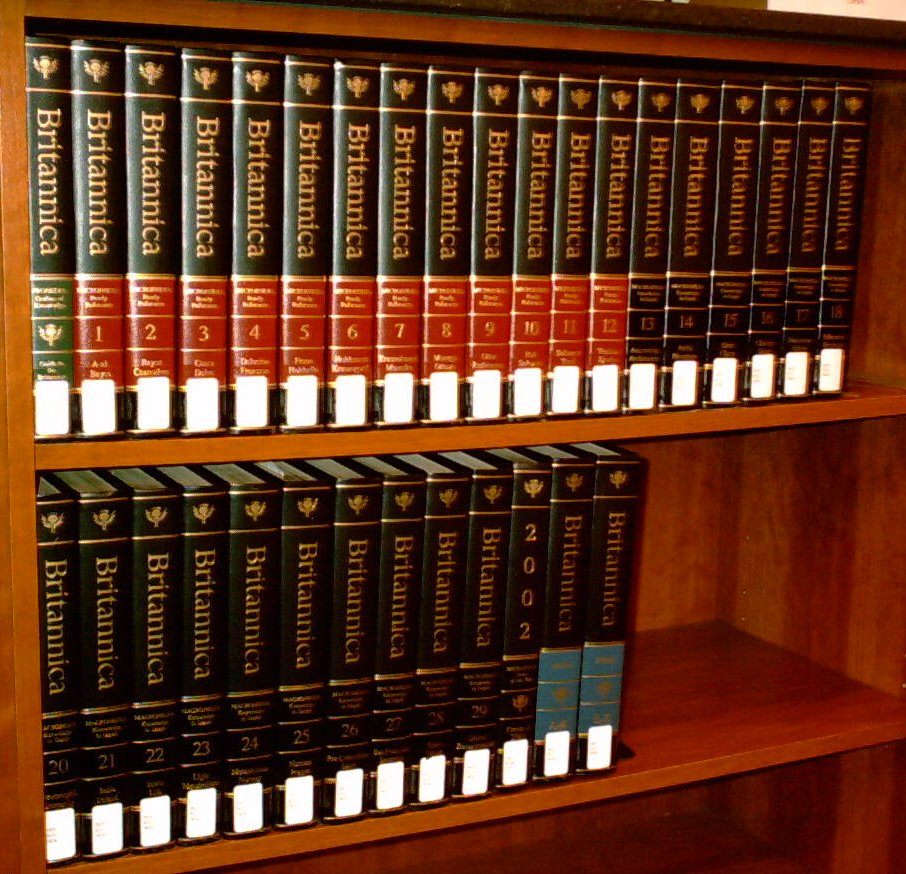
I have long had a love affair with encyclopaedias. When I was a child, we had several sets, pitched at different reading levels. We also subscribed to encyclopaedias delivered in weekly or monthly installments: Finding Out and The Book of Knowledge. I spent many happy hours browsing from one article to another, following a trail through ideas and concepts.
We bought the Encyclopaedia Britannica for our own children, all 16 volumes of it, plus yearly supplements. In a big clean out several years ago, we sent the whole set to a book fair. I had a moment of nostalgia, but had to acknowledge I'd not cracked a cover of any of the books for years. The electronic encyclopaedias we own are so much easier to use. And that doesn't even begin to take account of the wealth of knowledge available on the Internet.
Johnson's latest post talks about the end - and new beginning - of another great reference work. What do you think? Are printed dictionaries a thing of the past?
This blog shares some of our thoughts about plain language, and the latest discussions about plain English and clear design in New Zealand, and around the world.
To find out more about Write, go to http://www.write.co.nz/ or join us on Facebook at http://www.facebook.com/WriteLimited
23 November 2012
20 November 2012
Clarity or obfuscation?
Eric Rosenberg, writing in Forbes, suggests that business can save money if it learns plain language techniques from business.
Many organizations default to opacity and obfuscation in their communications. Clarity of purpose is crucial in business. But many within organizations have difficulty expressing that purpose – whether it’s in a mission statement, a news release, or an internal marketing presentation. The result isn’t surprising. As workers grapple for clarity, there are more meetings about meetings, more memos about memos, more time and resources spent clearing away the brush in an attempt to reveal a purpose.and
...in the business world, lengthy presentations often are rewarded over substance, and jargon is confused with intelligence. Real words are lost and, as a result, the ideas buried.Read the article for more about the diagnosis and the solution.
14 November 2012
Hiding meaning isn’t 'plain English'
People think that plain English is about using simple words. Plain English goes beyond that. It is about making meaning clear.
This blog caught our eye. The writer used plain English to deconstruct a series of advertisements written in simple words.
Read Richard Boock's blog 'Plain talk about plain cigarette packs'
This blog caught our eye. The writer used plain English to deconstruct a series of advertisements written in simple words.
Read Richard Boock's blog 'Plain talk about plain cigarette packs'
13 November 2012
Plain English on the coffee menu at Debenhams
UK store Debenhams has come to the rescue of coffee drinkers who'd like to try something new, but are nervous about seeking explanations of the confusing coffee names. The Daily Mail reports:
On the store's deconstructed menu, a caffe latte is described as 'really really milky coffee', cappuccino as 'frothy coffee' and caffe mocha as 'chocolate flavoured coffee'.
Black coffee is 'simple coffee, with or without milk', and an espresso shot is labelled as 'a shot of strong coffee'.
11 November 2012
Understanding the fiscal cliff
Yet another picturesque term from the language of economics is making headlines, especially since the US elections. This time it's the 'fiscal cliff'. Find out more in this article from The Atlantic. And is it a cliff or a slippery slope?
Read about the fiscal cliff
06 November 2012
Proofreaders 2; spelling checkers 0
We love our skilled proofreaders. They save us (and our clients) from looking dumb and careless. Sometimes, they can even save lives.
One of our clients sent us a snip from a response to a report on a major health and safety investigation. The response listed the recommendations then what the respondent planned to do about them. The final recommendation was mistyped to suggest that organisations have:
Many years ago, I worked on an instruction guide for locomotive engine drivers that said something like:
One of our clients sent us a snip from a response to a report on a major health and safety investigation. The response listed the recommendations then what the respondent planned to do about them. The final recommendation was mistyped to suggest that organisations have:
modern equipment and fatalities.Ooops. We checked the report. Sure enough, it recommended:
modern equipment and facilities.The error was particularly inept given that fatalities were the reason for the investigation.
Many years ago, I worked on an instruction guide for locomotive engine drivers that said something like:
The driver must halt the locomotive and must not proceed until the light is eliminated.That was easy to rewrite.
Stop. Do not start until the light goes off.It didn't make sense to me. I brooded about it, then rang the client. Sure enough, the word 'eliminated' should have been 'illuminated'. Final version.
Stop at the red light. Start when the green light goes on.Spelling checkers don't replace proofreaders. Game, set, and match.
05 November 2012
Parking fines are always annoying — but the letter didn’t help
The tone of the letter I received from the rental car company telling me of my ‘Parking infringement’ didn’t help. They sent a standard letter that was written some time ago, maybe years ago.
Upon a search of our records, we have determined that you were renting the vehicle at the time the infringement was incurred. Please find enclosed a copy of your rental agreement, the terms and conditions of your hire, and the infringement for your reference.I’m going to Christchurch in two weeks, and I’ll rent a car from someone else. Once standard letters are written, they are not OK for all time. Reviewing and updating the tone and the language of standard letters is an important part of managing client relationships. The rental car company needs to review and rewrite this one in contemporary, everyday language.
It’s extra annoying that the ‘infringement was incurred’ in Wellington, while I was renting in Auckland. By the time I found out there’d been a mix-up and the parking fine wasn’t mine, the rental car company had already debited my credit card ‘for the considerable paperwork involved in transferring an infringement, under the terms and conditions of your rental agreement (enclosed), a $58.49 (incl. GST and credit card surcharge) administration fee payable to … for processing each infringement. We noticed you had nominated a credit card for further charges and have therefore processed the charge accordingly. A receipt is enclosed.’
‘Kind regards’ at the end didn’t quite fit.
Here are some ways of thinking about tone when you write.
- Tone is the impression the writer makes on the reader.
- Tone is about considering how the reader will feel.
- Tone is a matter of attitude: your choice of words, your sentence structure, and your content combine to display your attitude to your subject and your reader.
- Tone will win you customers, or lose you business.
Subscribe to:
Posts (Atom)

